Gum ball
Swelling of the gums is a frequent reason for consultation, and is usually associated with oral infections or abscesses.

The symptom
They are commonly described by patients as a ball appearing on the gum.
If you experience this kind of symptom, make an appointment with a dentist in Geneva CMD Balexert.

Visual appearance
They appear as a blister on the gum, sometimes fluctuating in size, with a whitish fluid that may drain spontaneously or on self-examination. Pain is not always present, sometimes fluctuating, and may even disappear overnight, often after the liquid inside the blister has drained away. Appropriate clinical management is systematically essential to avoid, even insidiously, the continuation of the process.
This swelling has two main causes:
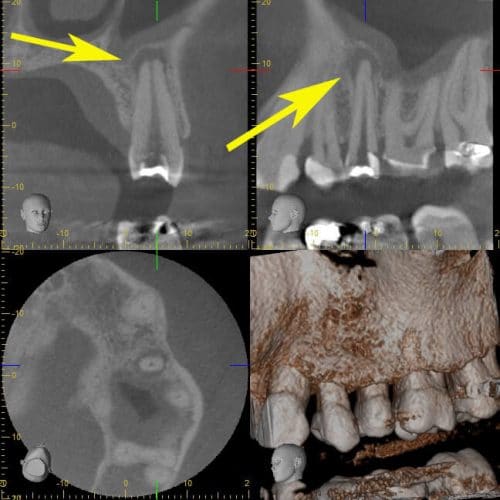
The dental cause
Located opposite a broken, decayed or restored tooth, it indicates the presence of a localized dental infection that drains through the gums.

The periodontal cause
Located in front of a tooth, it indicates the presence of an infection of the tooth’s supporting tissues (gum, bone, desmodontal ligament), which are degraded by bacteria.
However, there are some special cases where swellings are not at all associated with teeth, such as salivary cysts, the after-effects of trauma or bone swellings (torus). Although often benign, it’s important to have them examined by a dentist to reassure you as to their nature.
What’s more, pregnant women are more likely to develop gum disease (gingival inflammation, abscesses, etc.) due to the altered oral balance during pregnancy. In the event of gingival symptoms (bleeding, pain, swelling, etc.), they are therefore urged to consult their dentist immediately to agree on the appropriate treatment for their stage of pregnancy.

Is a dental abscess a dental emergency?
A dental abscess is a pocket of pus that forms in the soft tissues under the gum, close to a tooth. It is a bacterial infection located around a tooth or the gum.
The bacteria can come from several dental problems: a cavity, a build-up of tartar under the gum, an old dental treatment, or a poorly positioned wisdom tooth.
A dental abscess does not heal on its own: you need to see a dentist promptly.

What are the symptoms of a dental abscess?
Symptoms usually begin with swelling of the gum or cheek, followed by intense pain. Depending on where the abscess is located, a discharge of pus or a bad taste in the mouth may also occur.
The infection is considered more serious if the swelling spreads to the face, the eye or the neck. Fever, as well as difficulty swallowing or breathing, can appear if a dental abscess is not treated in time and progresses. This situation can then become dangerous for the patient.
What should you do if you have a dental abscess?
- Avoid sources of heat on the cheek: they make the inflammation worse.
- Rinse the mouth gently with warm salt water.
- Take a standard painkiller, taking the patient's medical situation into account.
- See a dentist promptly: it is the only step that treats the cause.
What is the treatment for a dental abscess?
The treatment consists of draining the infection to allow the pus to escape. Drainage can be carried out in different ways depending on the cause of the dental abscess.
After the area concerned has been anaesthetised, a small incision is made in the gum. In some cases, the pus can also be drained by passing ultrasound between the gum and the tooth. Rinsing is carried out at the same time to remove as many bacteria as possible.

When faced with this sign, remember that the most important thing is always to consult without delaying treatment. Your dentist will be able to diagnose the problem as soon as possible, and will be able to offer you the best possible information and treatment.
Care for this problem

Gum treatment
Practitioners who can help with this problem