When to seek emergency dental care
Not all dental emergencies call for the same speed of consultation. This list, which is not exhaustive, helps you gauge how urgent your situation is.
Come in as quickly as possible
Dental trauma
A permanent tooth knocked out (lost)
- If possible, put the tooth back in its socket, provided it is clean and there is not too much other damage in the surrounding area.
- Otherwise, keep it in saliva, milk or saline solution.
- The sooner the tooth is professionally put back in place, ideally within the hour, the better its prognosis.
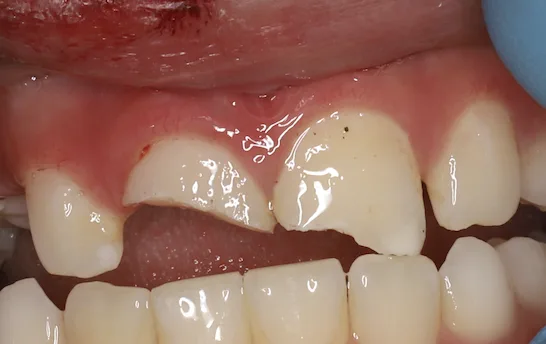
A permanent tooth broken or displaced. The criteria for urgency are:
- the nerve is visible (a red or pink dot);
- a large piece has broken off;
- the tooth is loose.
An infection or an abscess
- swelling of the cheek or the gum;
- high fever with dental pain;
- difficulty opening the mouth;
- presence of pus, a persistent bad taste in the mouth.
Depending on how urgent the situation is, hospital care may sometimes prove necessary, especially where one of the following warning signs appears following a dental infection:
- difficulty, or even inability, to breathe or swallow;
- significant swelling spreading towards the neck or the eye.

Prompt care, without every minute counting
Other dental emergencies call for prompt care, but their prognosis is not worsened by every passing minute:
- intense pain, throbbing or persistent;
- pain that prevents sleep;
- pain that prevents eating;
- pain not relieved by the usual painkillers.
A problem after dental care
- bleeding after an extraction that does not stop after 30 to 60 minutes of pressure;
- pain after a dental extraction, if it worsens after 3 to 4 days and does not improve after taking the prescribed painkillers;
- an orthodontic appliance badly injuring the mouth;
- a loose crown or bridge exposing a sensitive tooth.
To be seen before long, without being an emergency
- a cavity with slight sensitivity;
- a sensitive tooth;
- a filling that has come out without significant pain;
- a small chip of a tooth with no pain;
- an irritated gum.
While you wait for your appointment
To avoid:
- any product applied directly onto the gum;
- applying heat to a swollen cheek.
What you can do:
- apply cold to the cheek;
- take a suitable painkiller, if you are able to, without exceeding the maximum dose;
- keep up your oral hygiene as best you can.
Trauma and dental accidents: priority care
Dental traumatology is the discipline that deals with accidents causing damage to teeth and their supporting structures, bone and gum.
Dental trauma is common, in the child learning to walk as much as in the reckless teenager or the adult who plays contact sports. A good initial reaction from the injured person or those around them, followed by appropriate professional care, is decisive for the prognosis of the teeth affected.
The size and accessibility of our centre mean that we regularly treat trauma cases. Our team is regularly trained in dental traumatology, in particular by the dental trauma centres of the Universities of Basel and Bern, which are the benchmarks in this field in Switzerland. We apply the treatment principles recommended by these centres.
What to do in the event of dental trauma?
Stay calm. Rapid care is certainly important, but dental trauma is never so urgent as to prevent you from taking a few minutes to analyse the situation calmly and set priorities.
Set priorities. If the injured person has lost consciousness, even briefly, or shows neurological problems (dizziness, nausea, visual disturbances, headaches, hearing problems), a general medical facility must be consulted urgently: hospital, clinic or walk-in centre. Only then should dental care be carried out. The same order applies to any severe trauma, a bone fracture or a major wound.
See a dentist immediately.
Depending on the trauma
- A tooth completely out of its socket, with its root. If it is a permanent tooth, it is vital to try to find it. Do not touch the root, do not rub or wipe it even if it is soiled, and store it as quickly as possible in cold milk. Not dry, not in water, not in saliva.
- A fractured tooth. If possible, store the fragment or fragments in water or milk.
- A displaced tooth or teeth. Try to reposition them gently, and do not touch them again if that fails.
At our centre, trauma is always a priority. The injured person will be seen even without an appointment. Where indicated, treatment will be given immediately. For trauma that is less urgent, the patient may be treated a few hours later, with all the time and attention required. So that we can welcome you in the best possible way, we nevertheless ask you to let us know you are coming by telephone.
Frequently asked questions
Keep the tooth or the broken fragment in saliva, milk or saline solution, and see a dentist as quickly as possible.
Care for this problem

Dental emergencies
Root treatment
Practitioners who can help with this problem